






After putting the Schwalbe Romy and Continental Magnotal through their paces for us, Ron Lewis (@OMTM.CC) turns his attention to pedals—specifically, the one part of his setup he’d never bothered to question. Three new trail pedal systems, one 25-year Shimano XT loyalist. Let’s see what he digs up.
Rule of Three: A Trail Pedal Trifecta
I have been a pedal monogamist for as long as I can remember. A Shimano XT lifer. But without a good reason why. It was the first system I tried. It worked. That was that. Twenty-five years later, I’m still riding the same pedals year after year without question. Shimano XT PD-M8100. Basic. Reliable. Minimal. Perhaps a bit boring. Is that a good thing?
I’ve upgraded almost everything else in my ride-life, evolving through a succession of disciplines over the years: road, gravel, cyclocross, adventure, bikepacking, XC, trail and backcountry mountain biking. Yet, for whatever reason, here I am still riding the same Shimano XT pedals I clipped into back in 2001. It never really occurred to me that (arguably) the most important touchpoint on the bike may deserve more thoughtful consideration. Might there be a better way?
That’s what we’re here to find out.
But first, some context. For the lion’s share of the aforementioned riding, XT pedals are fine—perfectly suited to the task, a sensible balance of form, function, and value. And by XT, of course, I mean the standard-issue, no-frills M8100 variety. But as my riding has drifted toward the rowdier end of the mountain-bike spectrum, that minimalist design has started to show its limitations: feeling precarious and light-duty once things enter heavyweight territory. Within this new domain, I find myself wanting something meatier. More platform. More bite. More connection. More support and control when things get steep, loose, and consequential. And, frankly, if we’re sticking with SPD’s, I’d like a bigger, cleaner target when clipping in on the fly. Because nothing kills commitment faster than stabbing at a tiny SPD mechanism—fumbling for that reassuring click while a steep rock chute drops away beneath you.
So let’s recap our wishlist: easy-in, easy-out, tactile control, more grip than float with a locked-in ride-feel. Too much to ask?
I teamed up with BikeTiresDirect to line up three contenders, each taking a swing at the same target: more pedal, more connection, better control. And while we’re at it, let’s add flat pedal-curiosity to the mix. Wolf Tooth, OneUp, and Crank Bros each approach the brief from a different angle, transcending the basic SPD with adjustable geometry and a massive platform to hybrid designs and pin-heavy grip. Three interpretations of the same basic idea—and three chances to find out whether bigger truly is better.
Jump to: Wolf Tooth CTRL Trail | OneUp Components CLIP | Crank Bros Stamp EVO
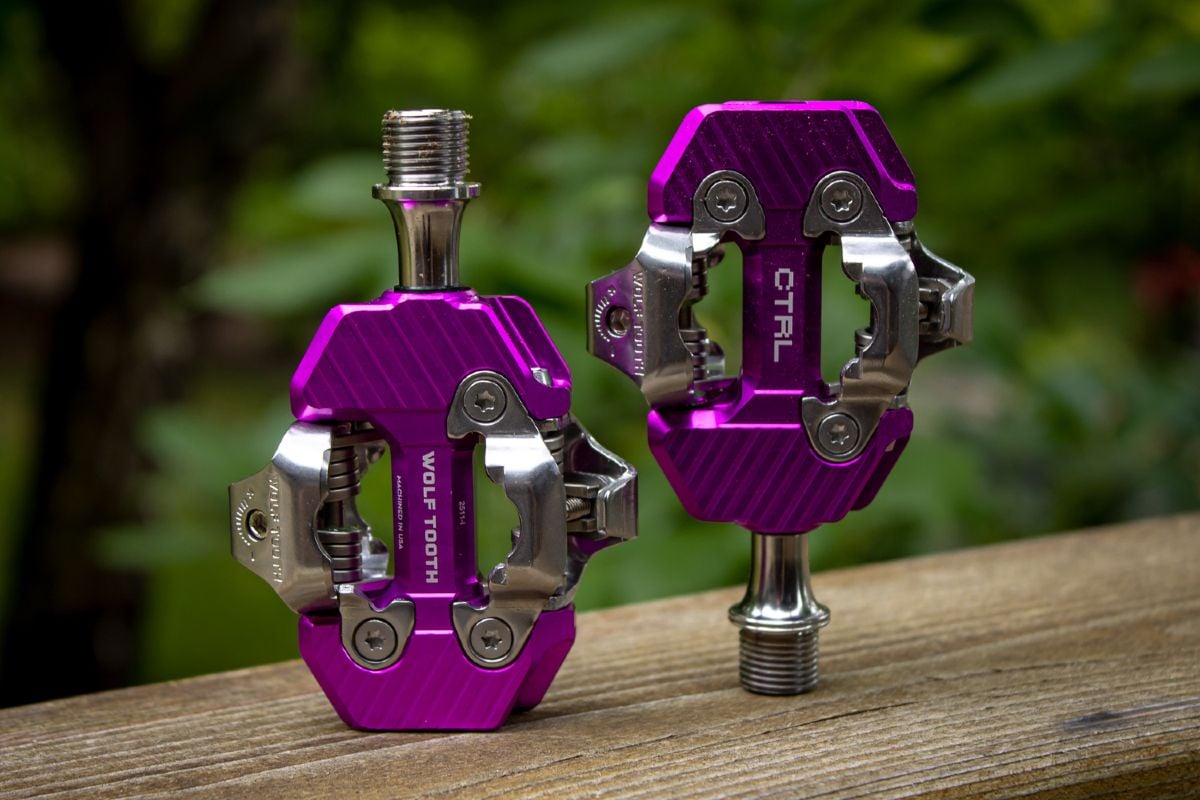
Wolf Tooth Components CTRL Trail: $219 | 326g
- Adjustable Q-factor
- Lightweight: 326g
- Large, secure platform maximizes pedal-shoe contact
- Right to Repair: fully rebuildable
- Slim 15mm profile
- Super smooth clip and release
- Buttery smooth bearings off the shelf
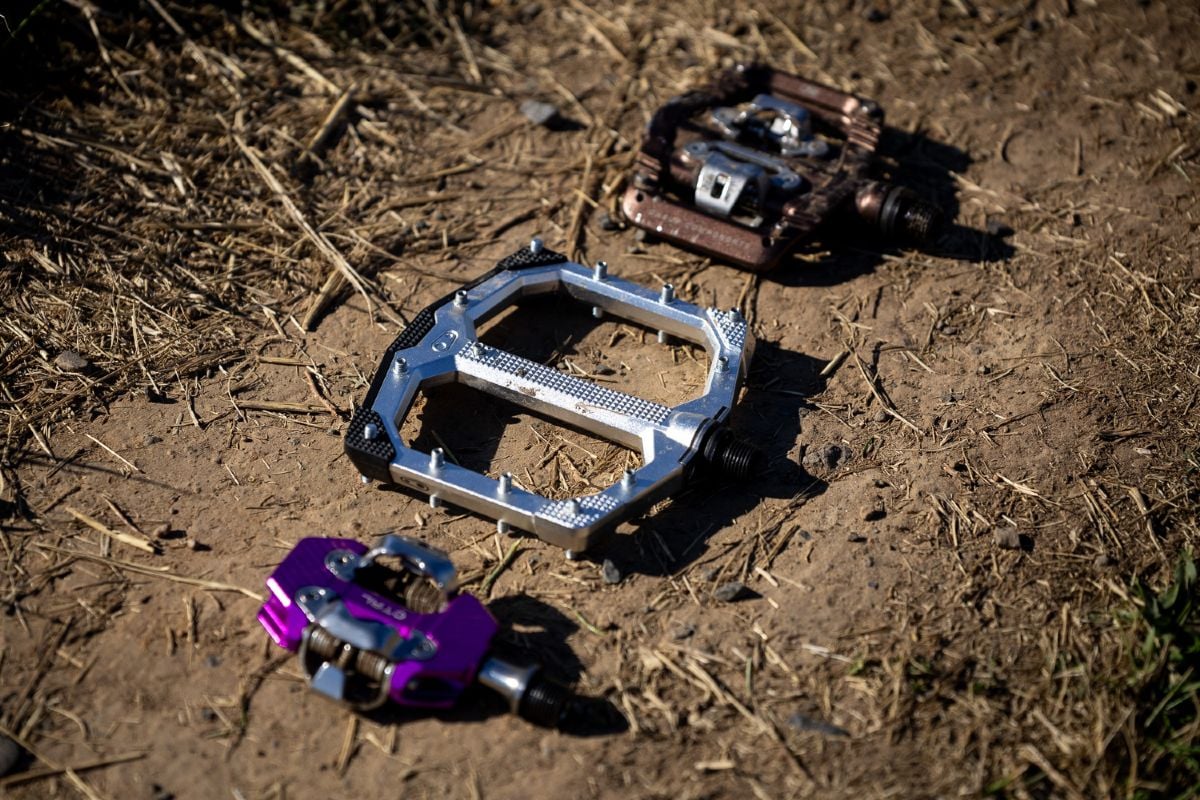
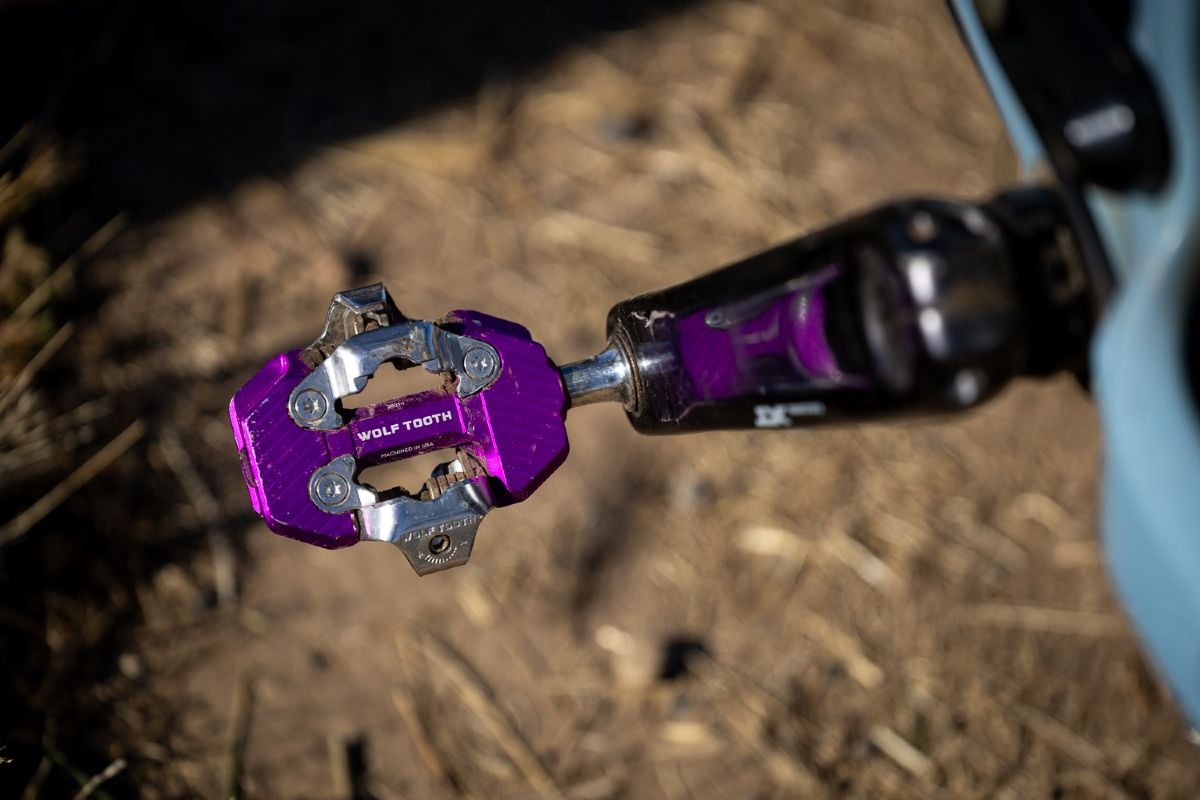
Released as part of Wolf Tooth’s CTRL, ALT, DEL, SHIFT quadfecta, the CTRL occupies the downcountry/trail category within the lineup of gravel race, XC, trail, and downhill clipless pedals. CTRL is aimed at riders looking for a tad more support than a classic SPD, but not quite the full platform and pin treatment of an enduro pedal. Slight with substance. Solid but not overbuilt. Additionally Wolf Tooth’s Right to Repair program means that CTRL is fully rebuildable with a complete line of replacement parts: body, spindle, bindings, spacers, bearings, tension screws, hardware…all of it. So in a manner of speaking, this puts Wolf Tooth in league with manufacturers like Chris King as champions of forever-builds.
Of the pedals tested, CTRL sits closest to the classic XT design I am used to. That said, the platform size and surface area surrounding the SPD mechanism are considerably more substantial, offering a wider, more stable target for clipping and tread support while riding. On my hardtail and short-travel Ibis Ripley, I found the CTRL to be a really nice, balanced middle ground with a quasi-magnetic clip feel upon re-entry—like your foot is somehow guided directly into position. And to be clear, I really notice the extra platform support once clipped. It adds a sturdy, locked-in confidence the XT lacks—and encourages me to let loose a bit more.
The CTRL may be my favorite of the three at this stage, particularly for XC and longer-form backcountry riding. CTRL is absolutely the smoother of the two SPD models in terms of engagement and release. They are extremely lightweight for the level of surefootedness. Another perk are bearings that spin buttery smooth right out of the gate, as so many arrive from the factory overly stiff, needing to be worn in. My take: CTRL is everything I love about the classic SPD experience, just turned up 20%—more refined, more robust, more of what makes SPD so damn good.
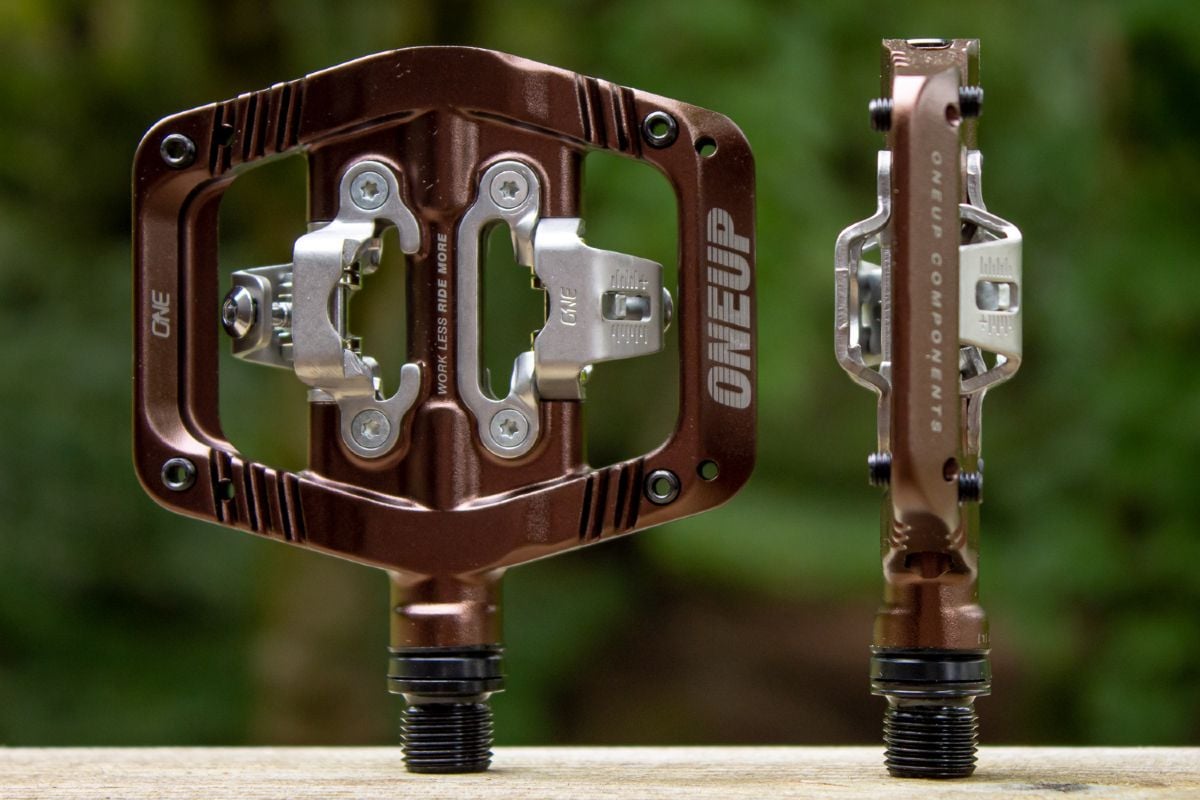
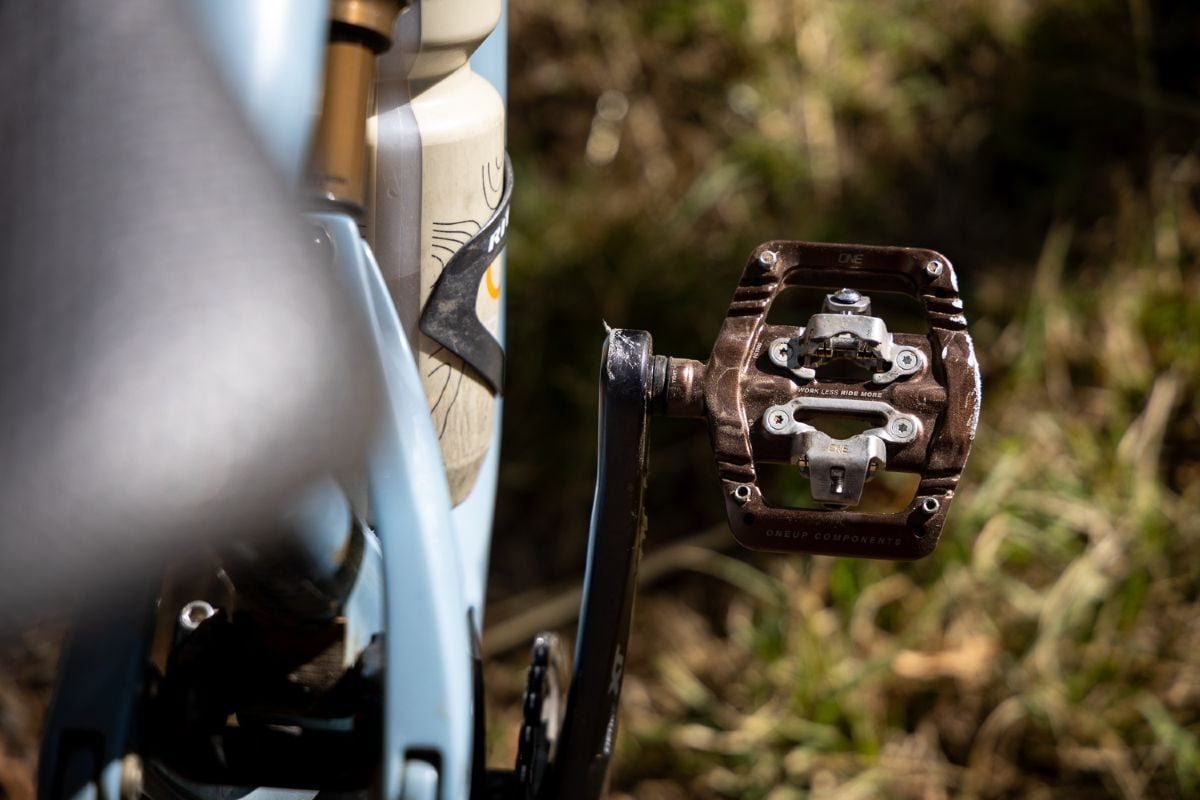
OneUp Components CLIP: $159 | 410g
- Hybrid SPD x platform design
- 80mm x 90mm platform
- SPD compatibility
- 5° float
- 8 traction pins per side
- Tight clip and release mechanism
- Bearings are quite stiff out of the box
Of the three-way lineup tested, the OneUp CLIP surprised me the most. Coming from a gravel/cyclocross background, I’d always been skeptical of bulky trail pedals. All that exterior platform seemed like extra weight for little tangible benefit. If you had SPD engagement, what did you need the cage for?
Turns out, quite a bit.
Aggressive trail riding involves a much more dynamic energy exchange than say—drop bar or gravel riding. Touchpoints in particular. Grips. Pedals. Tires. When you’re throwing your bike down rowdy chutes and drops at speed, an extra-sturdy, locked-in pedal interface starts to make a LOT of sense. I’d considered a few trail pedals in recent years, but nothing seemed to justify the extra…well, everything. OneUp’s CLIP is the pedal that changed my mind.
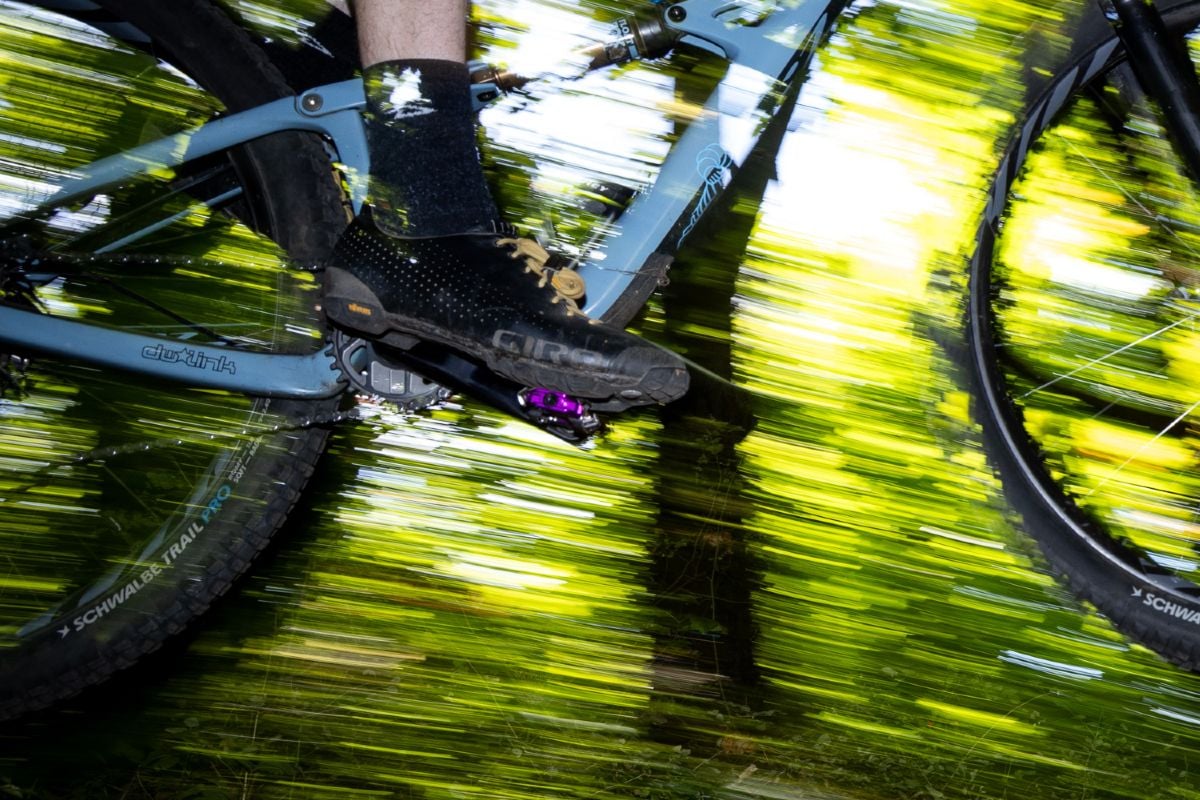
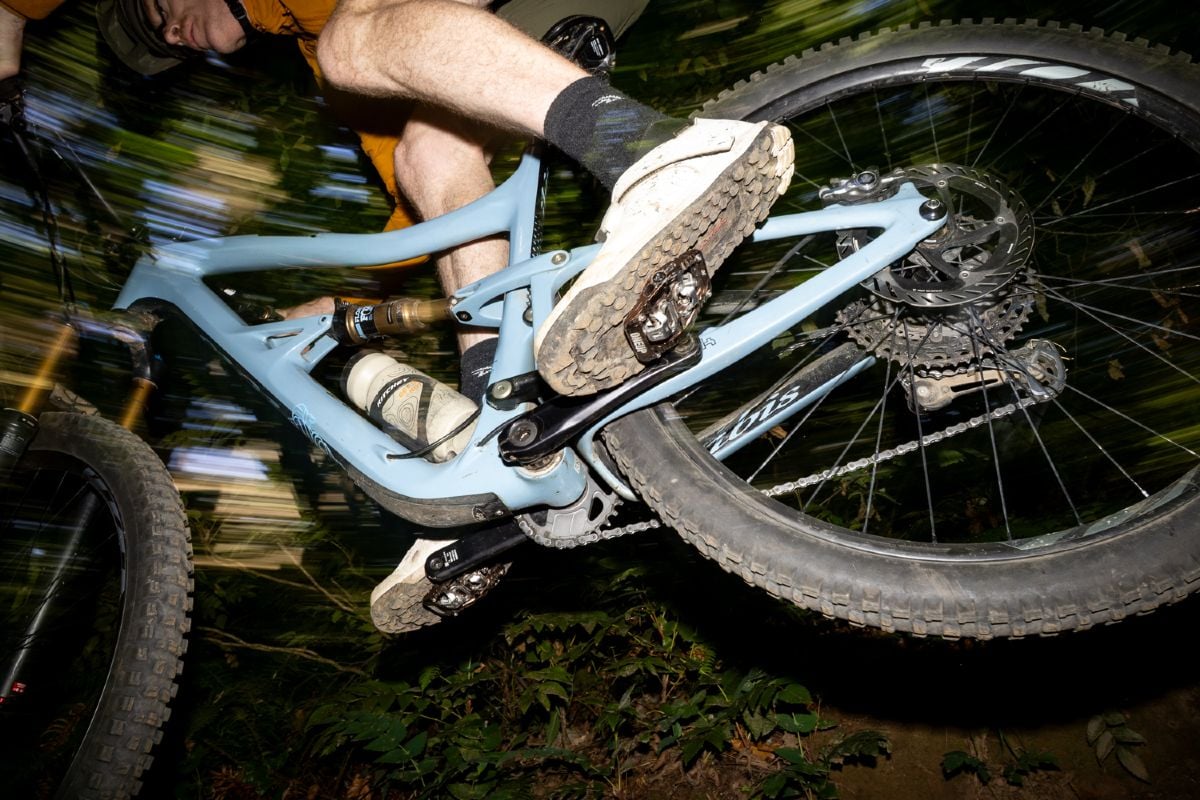
The CLIP really shines when paired with proper trail shoes—my Shimano GE900 HS, namely. One caveat: the CLIP’s SPD mechanism runs tight, even tighter with dirt, mud, and sand in the mix; so tight, in fact, that I had to dial the release tension almost all the way out. But once I had that sorted, the whole pedal/shoe interface clicked exceedingly well. Pun very much intended. The GE900’s recessed cleat layout meshes almost perfectly with CLIP’s broad platform and pins. And about those pins: the CLIP has eight traction pins per side, cleverly situated just off the sole under light pedal pressure. This allows a comfortable 5° of float while seated and pedaling, but dig into a descent and drop your heels, and suddenly the pins bite deep for a whole other layer of grippy support.
What really sold me, though, was the platform itself. It is big and textured and thick. On long, rough, backcountry sessions, the beefy platform spreads the pressure across my entire sole rather than hotspotting around the cleat; a world of difference from a minimal XT or even the CTRL. And it makes sense: more support over a wider area equals fresher feet all day. The effect is marginal at first, but after bashing down 3000 feet of moto ruts and root cascades, it adds up significantly. There’s a palpable damping effect too—less chatter transmitting up through the sole, and a noticeably planted pedal-feel underfoot. So, thanks to the CLIP, I’m definitely a platform-and-pins convert for deep, technical trail riding.
Crank Bros Stamp EVO: $199 | 464g
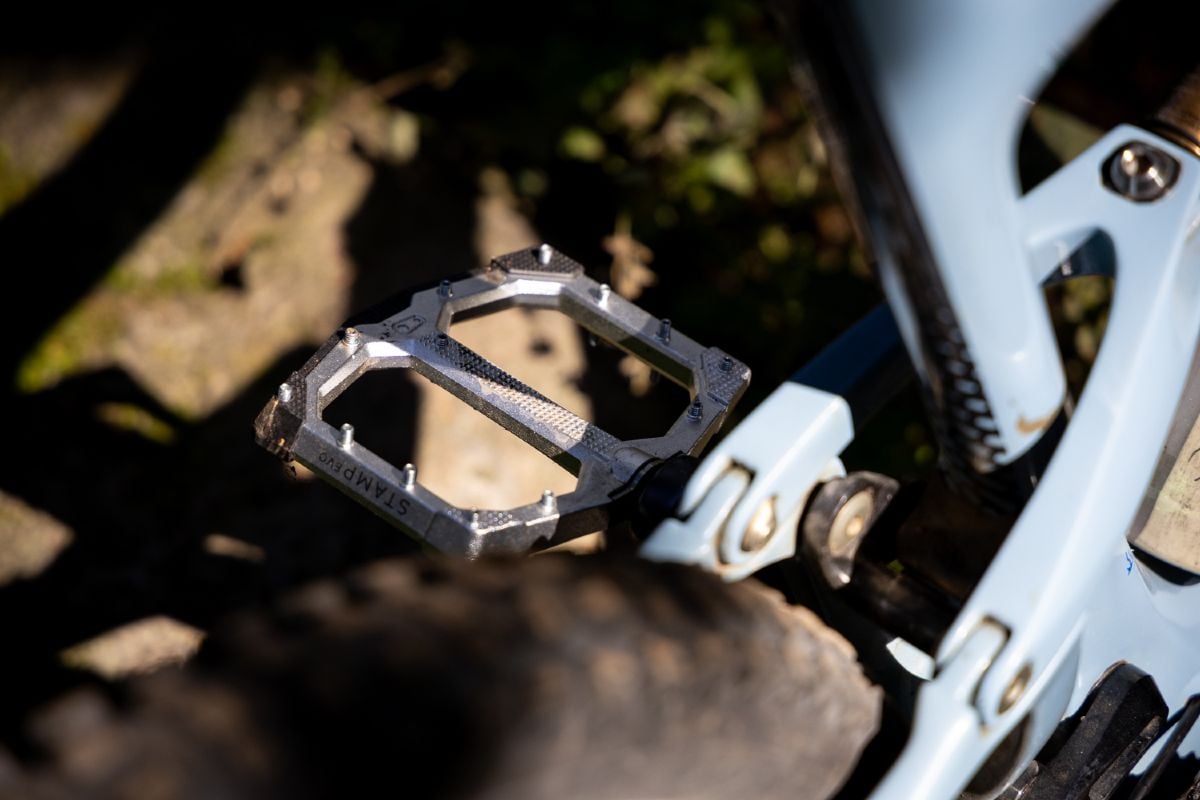
- Massive 114mm x 133mm platform
- Thin, convex profile: 11mm center to 15.5 edges
- Tapered, scooped-out pedal-feel
- 13 adjustable pins per side
- Available in large and small platform diameter
- Replaceable bash guards and traction pins
- Fully-rebuildable with refresh kits available
- A bit on the heavy side
A caveat: This is a flat pedal. I’m a lifelong clipped-in rider, so some of what follows is inevitably a reaction to flat pedals as a category rather than to the Stamp EVO specifically. I do my best to separate the pedal’s particular character from my own relative newness to flats, but the latter is an inescapable part of the equation. In other words, I’m reviewing Stamp EVO through the eyes of someone who has spent a lifetime on the other side of the aisle.
But before we can talk about any of that, let’s talk shoes. Flat pedals force a reckoning with shoe choice that SPD-folk like myself have been happy to skip until now. After querying a number of flat-inclined pals, it was determined that classic Vans balance grip, pedal-feel, and civilian wearability in a low-commitment package. SOLD. I went with the Half-Cab mid-rise. Technically a skate shoe, the padded uppers and sticky soles seemed appealing for rowdy trail-jostling. Let’s see how this goes.
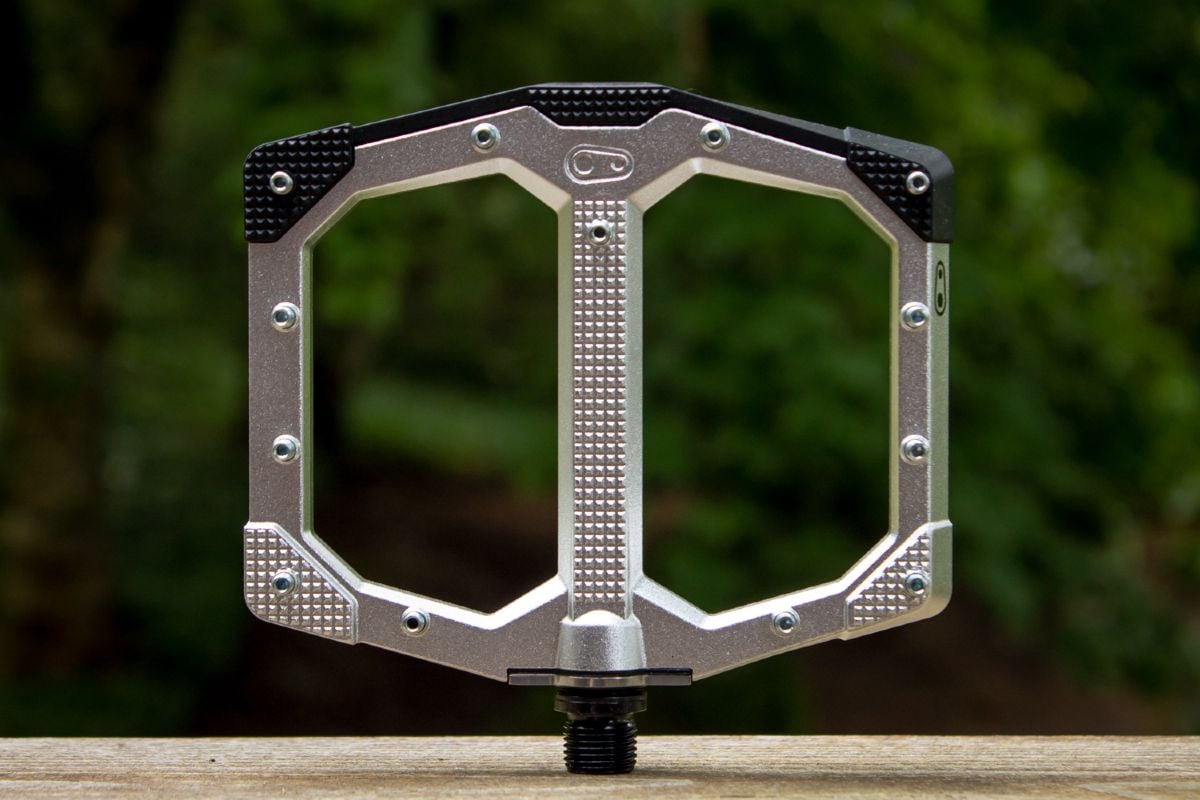
First off, these pedals are absolutely MASSIVE. Longer than they are wide. Like slices of Texas toast, if Texas toast were made of bear traps, which is to say: Big and Toothy. Within the Crank Bros lineup, Stamp EVO is a solid 20% longer than the classic Stamp 7 design at 133mm. More pins too. I wear a size 13, so this is a pedal that gets me. That said, I do wonder if we’re nearing a threshold beyond which pedals become TOO big. I don’t think we’re there yet—but we’re getting close.
Let’s dive into a few of the key standouts. Like the CTRL, Crank Bros’ Stamp series pedals are fully rebuildable with available refresh kits that include bearings, spindles, retainer bolts, O-rings and such. The EVO also comes with an extra set of bash-guards and replacement pins. I’m loving this trend. Next there’s traction: make no mistake, this is an ultra-grippy pedal. Like, TURBO-grip. Next to my Burgtec MK4s, the Stamp EVOs feel positively glued to your feet. The deep 4.5mm concave profile and massive footprint work together, locking your sole firmly in place—especially with flexy kicks like Vans—for an absurdly planted ride-feel. Even in wet, rainy conditions I actually found it hard to adjust my stance without fully peeling my feet from the pedals to reposition. Is there such thing as too much grip?
After 25 years of being mechanically attached, having my feet simply there still feels odd. There’s no clip to hold you in, no spring tension to dictate control—just your feet and a whole new awareness of pressure, position, weighting and pedal stroke. Between the Stamp EVO’s enormous platform and grip enough to hold an Alpine Marmot upside down, when your foot is planted, it’s planted. Fantastic when railing the rough stuff, dropping your heels and locking in; less fantastic when you want to micro-adjust under pressure or need to finesse bigger roots and rocks. Pedal-strikes are a thing with these—hence the bash-guards. The slim profile mitigates this somewhat, but EVO’s sheer size is never not going to be a factor. Learning curve aside, the Stamp EVO makes an extremely compelling case for oversized flats, suggesting we may have reached the end of the flat-pedal traction curve. For better or worse. Like I say, I’m still learning the language, but I’m beginning to understand the appeal. Sometimes freedom just takes a little getting used to.

THE VERDICT
Three pedals, three takes on the same assignment and, ultimately, three very different answers.
Wolf Tooth CTRL Trail is the one I find myself reaching for most often. It’s the natural extension of the SPD I already know: more platform and more meat, without sacrificing the simplicity and familiarity that made me an XT lifer in the first place. I will be using these going forward on my hardtail and short-travel XC bike. Light, exquisitely constructed, and exceptionally smooth, it strikes the best balance of all three: CTRL lands right in the Sweet Spot.
OneUp CLIP is the revelation. It took the longest to win me over and ended up making the strongest case for stepping up to a big platform-and-pins SPD. Once dialed, the combination of broad support and clip-enhanced control is remarkably empowering, particularly on long, fast, technical trail descents. This is the Gateway Drug to bigger, rowdier terrain.
Crank Bros Stamp EVO flats are something else entirely. Massive and supernaturally grippy, it offers the most tactile connection of the three—but also the steepest learning curve for a lifelong clipless rider. The freedom is real. So are the tradeoffs. I’ll be using the Stamp EVO most often for bikepacking, commuting, and all things adventure-casual. This one earns its position as the Wild Card.
As for me? After 25 years of pedal monogamy, I’m not quite ready to abandon my XTs just yet. But the relationship is officially complicated.